
Postdoc proposal 2010-2011
Virtual plant reconstruction mixing incomplete geometric
data and a priori knowledge
 |
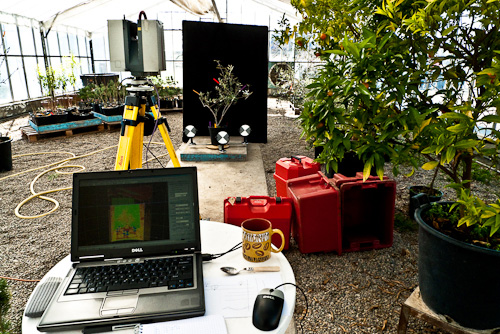 |
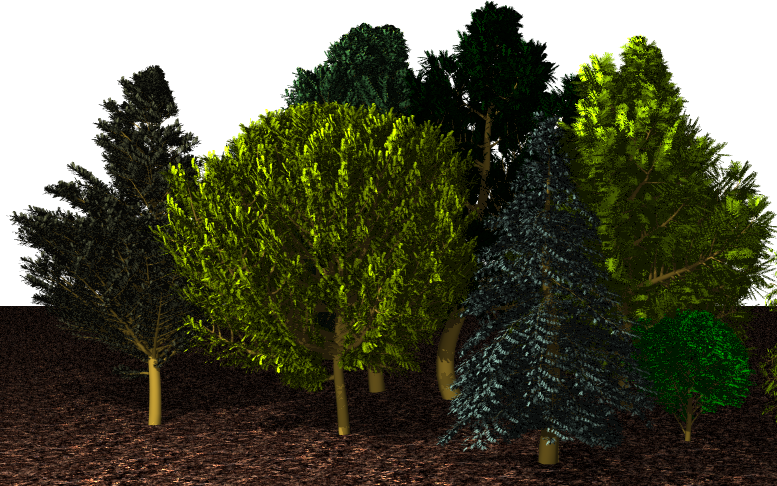
| Virtual tree [WBCG09] | Scanning a tree |
Advisors
| Marie-Paule Cani | Franck Hétroy |
| LJK/EVASION | LJK/EVASION |
| E-mail: Marie-Paule.Cani@grenoble-inp.fr | E-mail: Franck.Hetroy@grenoble-inp.fr |
| Tel. : 04 76 61 54 32 | Tel. : 04 76 61 55 04 |
Context
Automatic digitizing of vegetal structures is a current critical barrier for the study of plant growth and functioning [SR97, GS05] in different research domains such as computer graphics, biology and agronomy. Recent apparition of laser scanners makes it possible to acquire precise point cloud representations promising new acquisition schemes. However, this data is often both noisy and incomplete, due to occlusions. Based on 3D laser scanner observation of plant branching systems and canopies, the goal of this postdoc is to construct a high-level geometrical model of the plant with sufficient accuracy for agronomical applications.
This work will be part of an INRIA ARC and Agropolis project called "PlantScan3D", which gathers computer scientists from 3 different INRIA teams (located in Grenoble, Montpellier and Sophia-Antipolis) and agronomists from 3 different INRA teams (located Clermont-Ferrand, Lusignan and Montpellier), from the university of Helsinki (Finland), and from the Centre for Forestry and Climate Change (UK).
This is a one-year position.
Objectives
Within the PlantScan3D project, several interns work, or will work, on distinct topics. For instance, one intern within our team will work during this summer 2010 on characterizing a leaf pattern, and recovering it on point cloud data. Other interns and researchers will work on reconstructing a single leaf using algebraic surfaces, on extending convolution surfaces to skeletons approximated by piecewise helices, and on computing topological skeletons on real plant and tree data.
The overall aim of the postdoc is to test the whole processing pipeline, for a branched system first without, then with leaves. In order to develop a robust approach (scanned point positions are noisy, and some parts of the plant/tree are missing in the acquired data due to occlusions), the branched structure of the plant will be based on the computation of topological skeletons using both input data and a priori knowledge. This will be done in cooperation with the INRIA Virtual Plants team in Montpellier. These skeletons, fitted with variable thickness, will then be used to reconstruct a convolution surface. This will be done in cooperation with the INRIA GALAAD team in Sophia-Antipolis. Finally, in order to apply this work to reconstruct plants with leaves, leaf patterns should be searched for and filtered out. This case will also be particularly useful to test the robustness of the algorithms in case of missing data (because there is much more occlusions in this case).
Pre-requisites
Required skills include computer graphics and geometric modeling techniques, with an emphasis on surface modeling and processing. Technical skills include C++, OpenGL and Qt programming. Interest for biology and agronomy will be a plus.
This position is located in Grenoble, but the postdoc will frequently visit our INRIA partner teams
Virtual Plants and GALAAD
in Montpellier and Sophia-Antipolis. He or she will also participate to the meetings with our
biologist partners, who provide us both input data and a priori knowledge about the plants and trees, and will be the final users of
the reconstructed models.
Keywords : virtual plant, reconstruction, skeleton, point cloud, topology.
References
- [GS05] C. Godin and H. Sinoquet. Functional-structural plant modelling. New Phytologist, 166 :705-708, 2005.
- [SR97] H. Sinoquet and P. Rivet. Measurement and visualisation of the architecture of an adult tree based on a three-dimensional digitising device. Trees: Structure and Function, 11 :265-270, 1997.
- [WBCG09] J. Wither, F. Boudon, M.-P. Cani and C. Godin. Structure from silhouettes: a new paradigm for fast sketch-based design of trees. Comp. Graph. Forum (Proceedings of Eurographics), 28 (2), 2009.